0:02
Yes, everyone knows that knowledge is
0:04
something very important in school. But
0:09
we want to show here that when
0:11
interpreting poems, for example, too
0:14
much knowledge or knowledge applied too
0:17
quickly can also be a trap—in a
0:19
twofold sense—and, of course, we will
0:22
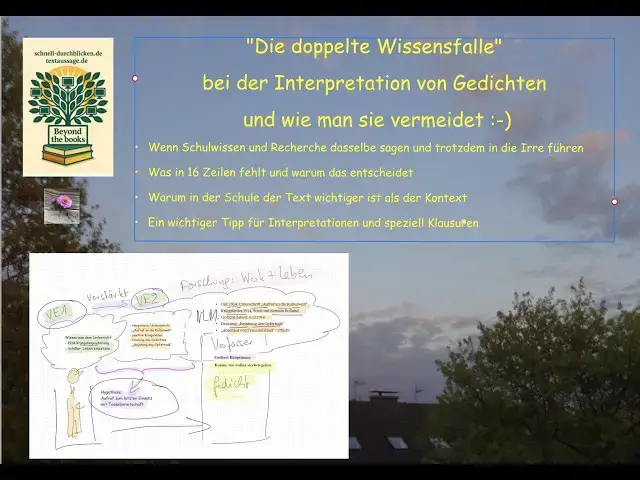
show how to avoid that. In this video,
0:27
therefore, we will explain what happens
0:29
. When school knowledge and research
0:33
say the same thing but still lead you
0:36
astray, what is missing in 16 lines of
0:39
a poem and why that is decisive, and
0:42
why in school the text of the poem is
0:45
more important than the context and
0:48
even what the poet said about it. This
0:53
is, above all, an important tip for
0:55
interpretations and, of course,
0:58
especially for exams. And here we have
1:01
a diagram that we will explain shortly.
1:04
Let’s take a closer look at this
1:06
diagram. Here is the student standing
1:11
in front of a poem that they need to
1:14
interpret. If they were diligent, they
1:17
have preconceptions; the first comes
1:20
from classroom knowledge: in 1914,
1:22
there was great war enthusiasm in
1:24
Germany, and they also covered Schiller
1:27
, who said in a poem: "And if you do
1:29
not stake your life, life will never be
1:32
won by you." And then this is further
1:35
reinforced by a second preconception.
1:39
Naturally not in the exam, but at home,
1:42
for example, one might consult
1:44
NotebookLM. consulted. Maybe we should
1:47
add that here as well. That is what we
1:49
used. And you adopt certain things, for
1:53
example, which is why it is identical
1:55
on the left and right here, that the
1:58
poet signed the "Manifesto of the
2:00
Ninety-Three" shortly after the
2:02
outbreak of World War I. The Germans,
2:05
especially the representatives of
2:07
culture, wanted to show the whole world
2:10
that their culture was something nobler
2:13
and that the others attacking them had
2:15
an inferior culture. And he signed it,
2:19
entirely in the spirit of national
2:21
sentiment and nationalism. He also
2:24
definitely wrote war songs in 1914 and
2:27
argued with a Romain Rolland—you
2:29
don't have to remember him, he was a
2:32
writer who was clearly against the war
2:34
from the very beginning. He had an
2:37
argument with him. And it is also
2:40
stated quite clearly that this poem,
2:43
which is the subject here—namely "
2:45
Come, let us go die"—affirms
2:47
sacrificial death and the farewell to
2:50
wife and child, viewing it as a duty.
2:52
We left that out on the left because it
2:55
is very biographical, but with the
2:57
other things, you feel you are on the
3:00
right track and then arrive at this
3:02
hypothesis. This poem shows a call for
3:06
the final mission with a willingness to
3:08
die. Now, we already pointed out
3:12
earlier that you should be a bit
3:15
cautious here and that the text is more
3:17
important than the biographical context
3:20
, right? Everyone knows that someone
3:23
can occasionally say something
3:24
different from what they said just
3:26
yesterday. And we’re going to take a
3:28
closer look at that in the poem now. So
3:31
, we’ve prepared the poem here a
3:32
little bit so it’s easy to follow
3:34
along. For instance, "Come, let us go
3:38
and die." Hey, please, which superior
3:41
tells their people, when they are about
3:44
to go into battle, that it’s all
3:46
about dying? Everyone hopes to be among
3:50
the survivors, after all. And then
3:52
there is talk of the dead, fists, and
3:54
cramping. That means it’s pointing
3:57
directly to the corpses, the dead, and
3:59
the terrible conditions in which they
4:00
died. Then it’s pointed out that back
4:05
home, the family situation, the
4:07
responsibility as a husband and father,
4:10
cannot simply be utilized. For what? We
4:13
will see that in a moment. At this
4:14
point at the latest, you have to arrive
4:16
at the question: what am I even
4:17
supposed to die for? And then, in the
4:20
third stanza, "Unless I am riddled with
4:23
holes, the campaign cannot succeed."
4:27
Here, for the first time, and the only
4:30
time, you get the feeling: that’s
4:33
what I should die for, so the campaign
4:36
succeeds. Who has an interest in the
4:38
campaign? Well, um, there’s a famous
4:42
case from the First World War where a
4:45
general sent his soldiers into a deadly
4:48
battle for a summit or a hill for the
4:51
sake of his career. There’s also a
4:55
famous film about that; we’ll link it
4:57
in the video info. That’s where it
4:59
becomes very, very questionable. And
5:01
also at the end, "Come my dear comrade,
5:04
may we both, equals, stand in rank and
5:07
file today, tomorrow lie corpse by
5:10
corpse." So, one sees something here.
5:15
This text presents the willingness to
5:17
sacrifice in such a pointed way that it
5:20
becomes questionable, and there is no
5:23
positive goal other than the success of
5:25
the campaign. You just have to imagine,
5:30
as a thought experiment, would an
5:32
editor who is supposed to stir up
5:34
enthusiasm want to print this poem?
5:38
Propaganda shows the greatness of the
5:39
sacrifice and the victory, not the
5:41
dying itself. Yes. Which coach, right,
5:45
would say before a victory, "Guys, you
5:47
have to fight your hearts out today,
5:49
and in the end, we’ll just lose."
5:52
That’s part of it. That, of course,
5:54
is completely out of the question. What
5:57
you can remember here is that level one
6:00
in school is always the text. The
6:03
analysis of the text is the first and
6:05
most important level. No matter what
6:07
else you know about the poet, that can
6:10
be added later. But that is important
6:12
for now. Life and work, building upon
6:15
that, one can classify literature
6:18
historically. In school, as I said,
6:21
level 1 takes priority. Meaning arises
6:25
in the conversation between teacher,
6:27
text, and reader in that exchange. And
6:31
by the way, scholarship also always
6:34
needs level 1. Texts must be read anew
6:37
again and again, otherwise the
6:39
so-called paradigm continues. A
6:42
paradigm is what one currently thinks
6:45
one knows. But that doesn't have to be
6:49
true; this prevailing view should and
6:51
must be verified. We hope we could
6:54
contribute to the idea that, even if
6:56
you have discussed it in class and find
6:59
during your own research at home that
7:01
it points in a certain direction, it
7:04
may not be true in every individual
7:06
case. One can sometimes be smarter than
7:09
the paradigm, one might say, the
7:11
prevailing opinion. There are materials
7:14
here on this page as always, and we
7:17
will add a button up here so everyone
7:19
can quickly get to the page for further
7:22
information to deepen the topic, and we
7:25
wish you success with independent
7:27
thinking and careful examination of the