0:02
Yes, in this video we want to look at
0:06
watermarks, specifically those found in
0:09
texts that have been written using AI.
0:15
So, it's a very dangerous matter for
0:17
anyone who just wants to submit texts,
0:20
regardless of how much they were
0:22
actually co-written by AI.
0:26
Let's take a look right now at what such
0:28
a watermark looks like, what it actually
0:31
is, what it shows, and above all, what
0:35
And then, of course, the crucial
0:37
question: how can you avoid problems
0:40
with such watermarks when using AI, or
0:42
perhaps with other control methods?
0:46
And at the end, we will address this
0:49
It actually explains the most important
0:52
part. Yes, we'll do it like this: on the
0:54
left, we actually have the full script.
0:57
Everyone can read through that
1:01
But we want to keep it shorter here.
1:02
We'll just do it the way you would with
1:04
texts in general. You write your own
1:07
summary on the side, and it basically
1:09
comes down to three things. In the past
1:11
, tedious self-writing and typing; today
1:15
, the use of AI, though with caution,
1:18
more or less. Yes, you can have it
1:20
written entirely for you, for example a
1:22
course history, or you have the basic
1:24
idea—as we definitely do now and then—
1:26
but don't feel like inventing all the
1:29
You let the AI do that, and that is, of
1:31
course, something completely different
1:33
in terms of your own contribution.
1:35
In any case, there is this video here,
1:38
which we will also link accordingly in
1:44
In it, a computer expert points out that
1:47
ChatGPT adds a watermark to texts.
1:51
And now you don't necessarily have to be
1:54
afraid, as we will show in a moment.
1:57
We'll try to keep this brief as well.
1:59
That means what was done in October '26
2:02
by the company behind ChatGPT goes back
2:05
to a European Union regulation, and it
2:08
serves as protection; because in AI,
2:10
many things can of course be changed—
2:13
photos, for example—and then things
2:15
don't look good at all, or people are
2:18
perhaps even evaluated based on scores.
2:21
Or in job applications, where AI plays a
2:23
role in the decision.
2:25
These are all things where we want at
2:28
least a machine to be able to recognize
2:32
that such a text was created with the
2:37
And, well, this is actually less about
2:42
But in school, something else plays a
2:44
role. We will briefly touch on that as
2:47
These are so-called AI detectors.
2:51
That is something different and
2:53
something much more problematic, because
2:55
you hear every now and then that some
2:57
doctoral thesis has been checked by
2:59
artificial intelligence for plagiarism
3:02
Meaning, did they copy from somewhere,
3:06
And of course, for a teacher, it can
3:08
also be very interesting to use such a
3:10
detector to see if a certain paper, a
3:12
term paper for example, was created
3:17
However, we will show later that there
3:19
is a much better possibility than having
3:23
something checked by AI or another
3:27
Yes, let's take a look at how that works
3:30
And the key here is the pattern check.
3:37
This means the AI simply checks whether
3:41
a certain sequence of words corresponds
3:44
to a typical pattern that AI uses, but
3:48
you can also polish the result
3:53
Hints are given here that you can
3:56
certainly exchange a few words and
3:58
similar things accordingly. It is also
4:02
important that this key lies with the AI
4:04
companies. That means the AI can
4:07
practically determine this in texts, and
4:10
that is obviously not simply passed on
4:15
A much bigger problem with these
4:17
watermarks is that they do not
4:19
distinguish between the thoughts
4:21
contained within and the wording.
4:24
This means the wording is checked quite
4:26
mechanically here. It doesn't matter if
4:28
it is an original idea or something like
4:30
that. The watermark programming is not
4:33
interested in that at all.
4:37
Um, that is why it is actually much more
4:39
important what detectors do, or special
4:42
programs that are aimed more at
4:44
identifying typical student language.
4:47
For example, stylistic features that
4:49
don't fit at all with how you usually
4:52
And one is naturally familiar with that
4:54
from homework that is submitted, where
4:56
the teacher looks at it and notes: no
5:00
Excellent phrasing. No, that is not the
5:03
student one normally knows from their
5:08
And that is why the tip at the end: it
5:11
is certainly sensible, when submitting
5:13
written work, to indicate if necessary
5:15
to what extent AI was used.
5:17
But most importantly, you must actually
5:20
master what is written there.
5:23
No matter who created it, if you can
5:25
defend it at the end, as it used to be
5:27
called for doctoral theses.
5:30
That means a conversation was held about
5:33
it, and if you showed that you had it
5:34
all in your head, then it was fine.
5:37
And that is of course the solution here
5:39
as well, especially with these detectors
5:42
, which might be used more frequently in
5:47
The exciting question now is the
5:50
How can you reliably determine that a
5:53
story, for example, or an expository
5:56
text was written by a human?
5:59
We tested this using the example of this
6:01
course story. You can find it here.
6:05
It originated from before the AI era,
6:08
and we took a closer look at it.
6:10
That is, we had the AI look it over, and
6:13
the AI then determined, "Yes, this looks
6:18
Essentially, this involved four types of
6:22
For one, there were careless mistakes. I
6:25
won't list them all now; you can read
6:27
through them yourself. Then, definitely
6:29
a unique style, a personal linguistic
6:31
signature, right? The cell phone becomes
6:34
the bone of contention that Marco stows
6:36
in his pocket. Yes, the AI can certainly
6:39
detect that. "Oh, that is relatively
6:41
unusual, the way someone phrased that."
6:44
"He apparently came up with that himself
6:46
." Or, very importantly, insider
6:48
knowledge. This story was written by a
6:51
teacher, and he knew that, um, chalk can
6:55
break, a fingernail then screeches on
6:58
the blackboard, or the German teacher
7:01
who insists it's not Mr. Norberg, but
7:05
Dr. Norberg. These are things that
7:07
matter in school, and so, anyone who
7:10
knows school will smile a bit here. You
7:12
have to have experienced such things to
7:14
be able to write about them
7:16
authentically. And then narrative
7:18
subtleties, like the rain from the first
7:20
sentence continuing through the story to
7:23
the end, and then the phrase "don't
7:25
leave them out in the rain."
7:27
But be careful, artificial intelligence
7:29
can certainly do that too; it sometimes
7:31
has a better overview than an author
7:33
does of their own story, or even small
7:35
weaknesses, for example, that a friend
7:37
named Mara is introduced at the
7:39
beginning and never appears again.
7:42
That is rather unusual. An AI would make
7:45
sure that such a character is actually
7:47
used again later. In any case, remain
7:50
cautious; these are all just indications
7:53
The AI can, upon instruction, of course
7:55
insert mistakes or invent school details
7:58
The hardest thing to fake is simply
8:01
lived experience that is told quite
8:03
casually. And we will go into that in
8:05
more detail in a moment.
8:08
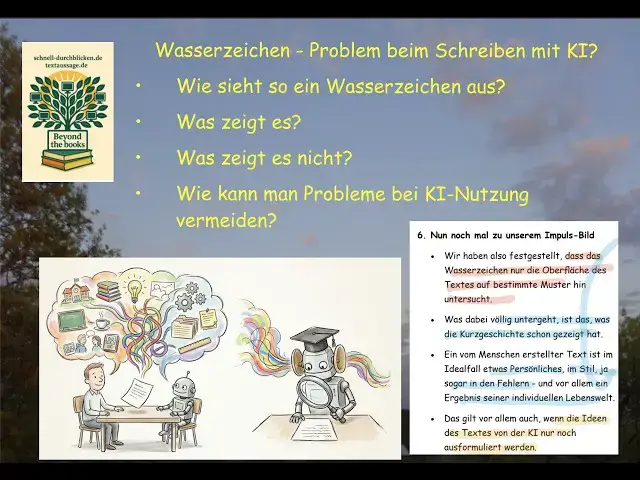
Yes, in the end, let's go back to this
8:12
We have here, so to speak, the AI, the
8:15
AI watermark program.
8:19
It only looks at the surface here.
8:22
It searches for specific patterns. What
8:24
gets completely lost in the process is
8:28
This is all that which plays a role in
8:30
the mind of a human who is writing
8:33
something themselves, like the things we
8:37
And the watermark doesn't pay any
8:39
attention to that at all, whereas
8:41
detector programs might take that into
8:44
A special case, of course, is when the
8:47
human basically had the idea—we often do
8:50
it this way—that we give the AI an
8:53
entire dramaturgy for a text. That's how
8:56
we want it. That is the train of thought
8:58
, but we don't feel like fully
9:00
formulating it again at the end, and
9:03
that is what artificial intelligence can
9:05
do. But ultimately, this remains a text
9:08
that belongs to us in terms of its
9:10
entire structure. This is the decisive
9:13
difference between these uh watermark uh
9:16
programs and what goes on in the human
9:20
mind, which then distinguishes a text as
9:25
Let's briefly summarize the crucial
9:28
point here again: whether you are
9:30
looking for a machine or for a human,
9:32
you always only arrive at probabilities
9:36
The real question, therefore, is not "
9:39
will I get caught," but rather "can I
9:41
explain and defend what is in my text,"
9:44
because only then have I truly
9:46
understood it; then it has become a part
9:48
of myself and my education.
9:51
That is the decisive point, and it is
9:53
primarily about explaining and defending
9:57
And you notice that immediately; even in
9:59
the past with PowerPoint presentations,
10:00
you could tell right away if someone was
10:02
able to say something when asked
10:04
follow-up questions.
10:05
That is the decisive difference.
10:08
What's important is, whoever can
10:10
collaborate with the AI, but in the end
10:13
has internalized it and can in turn
10:16
explain it to others.
10:19
They have used the AI as a tool, and
10:22
schools should be happy when students
10:25
master this skill; because that will be
10:28
what defines the future, namely, that
10:31
there are people who work optimally with
10:35
artificial intelligence, and in the end
10:38
, the result is as good as it can
10:43
And anyone who wants to look into this a
10:46
bit more closely can go to this page
10:50
There, as always, you'll find
10:52
corrections, additions, answers to
10:54
questions, and we will place this button
10:57
here up at the top so that it's easy to
11:01
In any case, we wish you much success in
11:04
the optimal use and defense of your
11:07
collaboration with artificial